
THE GLIMPSE
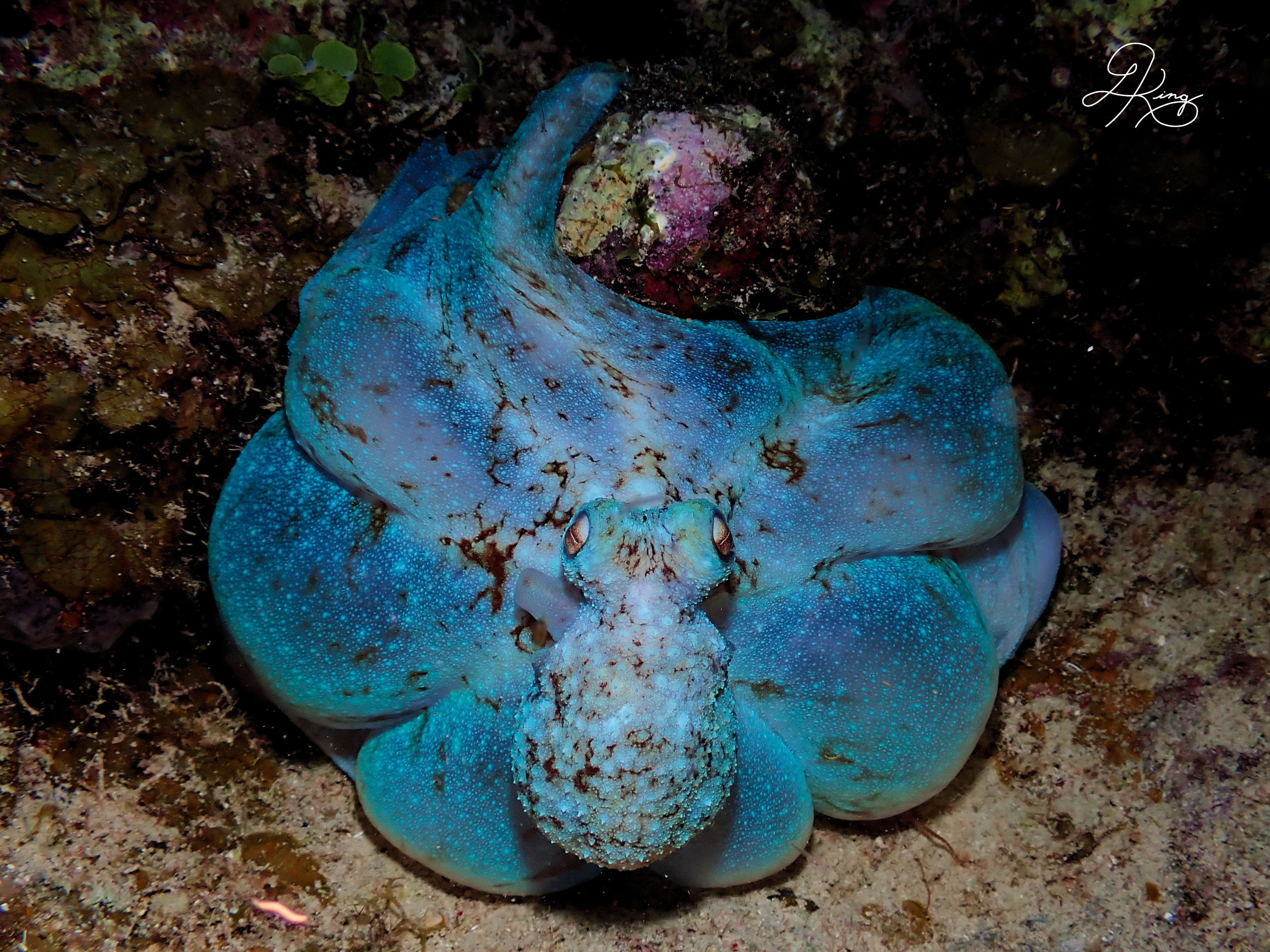
It is dusk. The water tumbles gently in place, rolling with a heartbeat beneath a soft breeze. As you descend onto a reef speckled with brightly colored sponges and luminous soft corals swaying in the dying light, you notice a flash of movement in your periphery—a jolt, quick as lightening, with a bright blue hue.
An octopus.
The excitement a diver feels at seeing one of these creatures is unmatched; they are difficult to catch a glimpse of even at night while active, and nearly impossible to find during the daytime.
Many marine creatures, like the octopus, utilize camouflage techniques to hide from predators or move stealthily while hunting. Others have developed a naturally camouflaged appearance through years of evolution, blurring into the reef and waiting patiently for an unsuspecting meal to swim by. Some, like the lettuce sea slug, look like their surroundings due to what they eat, in the same way pink flamingos gain their color through diet (however, pink flamingos don’t quite blend in).


Camouflage is an incredible ability, and there’s more than one way to do it successfully. Background matching, or “blending in” to your surroundings, is common. For example, sharks have two-toned skin designed to help them blend in from both above and below—while looking down onto their backs, their dark skin matches the reef and deep water; and, while looking up, a shark’s light belly mirrors bright sunlight streaming down. Other animals use mimicry, where they pretend to be something else. Male cuttlefish utilize this technique when attempting to mate—if they are too small to get past a larger male, these cuttlefish can tuck in their arms and pretend to be a female, sneaking past the competition undetected and successfully securing a mate.
We’d like to share with you three hidden creatures and masters of disguise we’ve stumbled across on our dives—the scorpionfish, the peacock flounder, and our favorite: the octopus.
To view a growing collection of our encounters, visit the gallery.


SCORPIONFISH
Home to a host of stealthy hunters, the family Scorpaenidae is not to be messed with. The two fish in our particular encounters are spotted scorpionfish, but other notable members of the family include lionfish, a species native to the Pacific that has become wildly invasive in the Caribbean, and barbfish, the scorpionfish’s little brother.
These animals are sit-and-wait predators, often residing motionless on the reef or seafloor until their meal of choice swims past; in a quick motion, their mouths open wide and suck in their prey with a gulp.
As their name suggests, scorpionfish are venomous. Puncture wounds from the spines on their foredorsal fins are fatal to many marine creatures, and are incredibly painful to humans. The threat of the spotted scorpionfish lies in their convenient appearance:
Scorpionfish are covered in feathery fins or skin flaps that help with camouflage against surrounding coral. Some scorpionfish are dull in color–mottled brown or yellow– while other species are bright red or orange, making them virtually invisible when hidden among either rocks or reefs.
Venomous and invisible is a lethal combination. How can one avoid something so well hidden? Take a look at the videos below from some recent snorkeling we did:
I was looking at a small critter and waving to Lewis, unaware of the scorpionfish that sat a meter away from me on the coral. It wasn’t until I swam around the structure and did a double-take that I suddenly noticed it there—even at point-blank range, these guys are good.


PEACOCK FLOUNDER
These strange fish have two telescopic eyes on one side of their body, allowing them to lay flat on the seafloor with near 360° vision. In their youthful days, flounders have eyes on either side of their head like any other fish, but as they mature into adulthood, one eye migrates over.
Peacock flounders swim with a dorsal fin that protrudes like a sail, waving it back and forth to propel themselves forwards. They use their strange eyes to see what they’re lying on top of, and subsequently change their coloring to match their background. Some species of tropical flounder can match the substrate beneath them in 2-8 seconds.
The changing of the colors is an extremely complex and not well understood process. It involves the flounder’s vision and hormones. The flounders match the colors of the surface by releasing different pigments to the surface of the skin cells while leaving some of the cells white by suppressing those pigments.
If one of the flounder’s eyes is damaged or covered by sand, the flounders have difficulties in matching their colors to their surroundings.
Like many species that camouflage, the flounder is an ambush predator. They hunt small crabs, shrimp, and fish. We got to witness this flounder above hunting, floating along the seafloor with its battle flag raised. See how its color changes after it strikes?


CARIBBEAN REEF OCTOPUS
A trickster of the sea, the octopus is the king of camouflage. Their complex skin can feature different types of cells: chromatophores, iridophores, and leucophores. Chromatophores are balloon-like sacs of pigment that can inflate and deflate, enlarge and shrink. They are controlled in thousands by a network of nerves that instruct each chromatophore’s actions. As one of these cells stretches, the color it contains becomes more visible (and as they shrink, the color disappears) creating a beautiful impressionist painting of pattern that can reflect nearly any environment.
Some species of octopus have iridophores, which use reflecting plates to create iridescent tones, and leucophores act like mirrors to the environment. All of these cells result in ever-changing Rorschach shapes all along an octopus’ body.
Octopus possess another camouflage ability: papillae. These are the spiky bits you see in the photo and video above.
…within [an octopus’] skin, muscle groups work in an antagonistic and agonistic manner, forming miniature muscular hydrostats. When activated, these muscles create dermal bumps called papillae… Different levels of structural complexity lead to larger and more intricate papillary shapes, with each species having a fixed repertoire of papillae shapes.
In essence, octopus can shapeshift into hundreds of patterns, colors, and textures, reflecting nearly any environment they’re faced with. And as if they couldn’t get cooler, these creatures can use their abilities not just to blend in, but to stand out—the blue-ringed octopus gets its name from the bright blue donuts it displays across its body to signal, don’t eat me, I’m toxic.
By far, crossing paths with these animals has resulted in some of our favorite and most memorable encounters to date. They are mesmerizing creatures, so different from humans physically, but so similar to us in personality, intellect, and parenting discipline. Looking into the eye of an octopus, one can only feel awe.
VANISHING ACT
I always joke with my diving students who want to see an octopus, frogfish, toadfish, scorpionfish, slug, flounder (or any other creature that can blend, for that matter) that we have probably seen one or two before, and we’ve definitely swam over countless others—we just never knew.
Mere moments after coming across a creature capable of disguise, they vanish yet again. It is hard to spot these animals, and after finding one, your eyes must focus with all their might to stay locked on the subject, lest they blend in again. It becomes a hunt, and one that is very rewarding. Searching for hidden things forces you to look more closely at the reef; the hunt gives you rich diving experience, one that is full of color, shape, pattern, texture, and beautiful, wonderful things.
Stay tuned for an audio snippet of this piece.
If you’re looking for more—like the full audio recording of this piece and future pieces on camouflage—subscribe to our Substack.
There, you’ll find exclusive blog posts, narrations of all written pieces, underwater poetry, and a monthly newsletter (featuring book, film, and podcast recommendations, current events, and behind the scenes shots of our work). Join our community below.


