

We know more about the surface of the moon than we do about
Dr. paul snelgrove
[the deep sea floor], despite the fact that we have yet to extract
a gram of food, a breath of oxygen,
or a drop of water from those bodies.

OVERTURE
It is 7:00 pm. Divers buzz with excitement, assembling their cameras and donning wetsuits, administering final checks on their equipment. The sun has just gone down, leaving nothing but dusk in its wake. Our boat sways and bobs along the rippling surface of the sea, drifting gently. We are about a mile from land; far past the coral wall, thus far past any realms of life—or so one might think. In reality, there is a magnificent show starting just beneath our boat—a circus of freaks, clowns, and elegance—and the performers are climbing towards the surface in greater numbers every second.
Each night, just after sunset, millions of deep sea creatures travel immeasurable distances from the depths all the way to the surface for one purpose: to feed. It is known as the “greatest migration on earth,” and it takes place across the entirety of the world’s oceans.

This nightly movement is made up of 10 billion metric tons of animals—a larger net movement of biomass than the migrations of caribou, wildebeest, or zebras on land or Arctic terns in the air. It includes everything from rice-grain-sized invertebrates like copepods, lanternfish measuring 10 centimeters (four inches) long, shrimp, squid, and gelatinous creatures up to 30 meters (98 feet) long.
During the day, these animals reside in the mesopelagic, or “twilight zone,” a region in the water column with only minimal light. At sunset, they move hundreds of meters upward under the cover of darkness to feast near the base of the food chain in surface waters where sunlight allows plants to grow. They descend again at first light to remain hidden from the eyes of their predators. Their migration is the equivalent to running a 10K twice every day and at twice the speed of an Olympic marathon runner.
Monteray Bay Research Institute, “While you were sleeping…” (2019 Annual Report)
Blackwater diving got its start in Hawai’i in the late 1990’s. The original divers were pioneers—with no buoy, tether, or extra lights, the first blackwater dives were done suspended freely in the water column, a hundred feet below the waves and miles above the seafloor. Soon, the procedure was refined, and dive operators began taking customers out on the experience. What began as an experimental form of underwater observation has now become an adventure that has exposed countless divers to thousands of wild things. While Hawai’i remains one of the best locations for blackwater diving due to its undersea topography, one can find incredible creatures in destinations such as the Philippines, Indonesia, Papua New Guinea, Grand Cayman, Florida, and more.
While anyone can enjoy blackwater diving, underwater photographers have developed a special relationship with the dark water. Photographing miniscule creatures in a bottomless soup is best described as both a challenge and a risk; however, this makes the reward—a stunning image of a miraculous life-form—even sweeter.
SPACEWALK
Striding off the back of the boat, we are thrust into pitch. This is not the ocean as we know it—bright, blue, colorful—yet already, the water teems with life. Our guide for the evening is a small buoy; known as the Mother, she floats aimless on the waves. A long tendril of rope falls beneath her, strapped with a dozen underwater lights, terminating at a stack of weights to keep her line taught. The torches point out from the her arm—they cast beams of light into the darkness, calling to the creatures of the deep.
Divers position themselves with their backs to the Mother, each with a personal beacon to spot and lure anything that floats by. With baited breath, we wait. Floating in the water feels far from walking on Earth; instead, it is a spacewalk, surrounded by particles and dust.
Weightless and free to roam, divers explore this new atmosphere, investigating the alien life that passes within our beams. There is no path, no route to follow. We drift along with the buoy, suspended miles above the seafloor. From the surface, one might see an incredible show of light, unaware of the expedition beneath. Each explorer is independent, circling the Mother in search of marvels, dancers, and freaks of the sea. After just a few minutes beneath the waves, the performers quickly make their way towards us—and what a show it is.
THREE-RING CIRCUS
Take your seats. Tonight, we have three curiosities to share with you, each bizarre and guaranteed to dazzle. These creatures are just a glimpse at what one might find while blackwater diving. Sightings range from organisms the size of a grain of sand to pelagic life larger a bus.
To view a growing collection of our encounters, visit the gallery.


Sea Butterfly
A strange and interesting creature, the sea butterfly is related marine snails; but instead of using their muscular “foot” to crawl along the seafloor, they take flight, soaring through the water column the way insects fly in the air. Like small ocean clowns—painted skin, oversized feet, flashy overcoats—sea butterflies are as amusing as they are awe-inspiring. And like most good clowns, they have a message.
Many sea butterflies posses thin shells made of calcium carbonate. These delicate shells are susceptible to degradation at the slightest change in their environment: namely, ocean acidification.
Most climate change discussion focuses on the warmth of the air, but around one-quarter of the carbon dioxide we release into the atmosphere dissolves into the ocean. Dissolved carbon dioxide makes seawater more acidic—a process called ocean acidification—and its effects have already been observed: the shells of sea butterflies, also known as pteropods, have begun dissolving in the Antarctic.
Smithsonian Magazine, “Amazing Sea Butterflies Are the Ocean’s Canary in the Coal Mine”
With tears painted downwards, sea butterflies delight the crowd, despite their mournful message. These alien creatures have warned us of something larger than ourselves—now, is is our job to listen.


Snaketooth Swallower
Snaketooth swallowers are the kings of illusion, making prey disappear before our eyes. Known to eat fish four times larger than their own bodies and ten times their biomass, swallowers can eat anything that fits in their mouth. They can expand their stomachs, allowing them to swallow fish whole. Snaketooth swallowers’ barbed teeth point backwards; in essence, they lock their prey in a living prison.
This swallower is still in its larval stage, learning the ropes and tackling less daring meals by traveling upwards to feed at night. These ray-finned fish live in the twilight zone, 700 to 3,000 meters below the surface. The scarcity of food at great ocean depths has led swallowers to develop this uniquely grotesque method of hunting, capturing, and digesting their pray. Many species of swallower have never been seen or photographed alive in their adult stages—considering the depths these creatures live at, it is rare for scientists to catch a glimpse. Instead, we learn about these animals by studying dead, captured specimens or by observing their larval and juvenile stages. Their translucent bodies and small but ferocious teeth bait our imagination, even now. We can’t help but look.


Sea Thimble
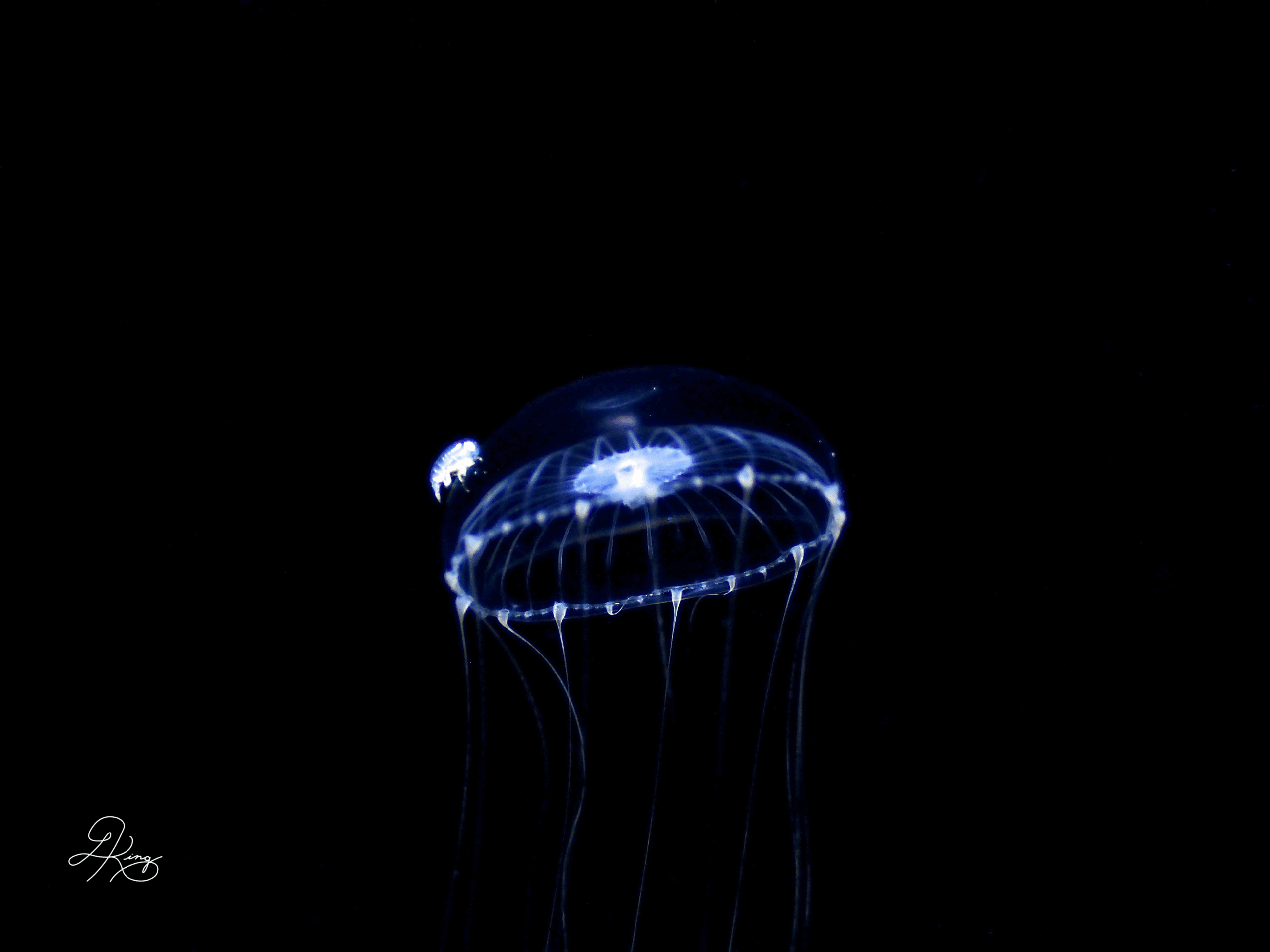
Using its bell to move through the water column, the sea thimble—also known as the thimble jellyfish—delights onlookers with a graceful dance and intricate biology. Sea thimbles are tiny, typically a mere 16-20mm in width, yet the complexity of their physicality is astounding. Like all scyphozoans, this sea thimble began as a benthic, flower-like polyp before detaching from the seafloor and undergoing metamorphosis, eventually taking on its recognizable medusa form. It is in this form that our ballerina lures its prey with a dance:
[The sea thimble] begins feeding by with swimming with bell pulsation to create a flow that draws in prey. Then the jellyfish extends four fishing tentacles, remain in a still position, and waits for prey to pass by. If a prey contacts one of the four outstretched fishing tentacles, then nematocyts [stinging cells], which cover the tentacles, discharge and attach to the prey’s exoskeleton. The tentacles complete feeding by bringing the captured prey into the mouth of the jellyfish to be digested.
Do you notice the orange patterning on our delicate sea thimble? More than an aesthetic detail, this adornment is actually another feeding method, a hitchhiking algae called zooxanthellae. The sea thimble and the zooxanthellae have an endosymbiotic relationship—in exchange for providing photosynthesized food produced from carbon dioxide to the jellyfish, the algae can live safely within its bell.
Unfortunately for beachgoers, the sea thimble’s dance is infectious. Trapped beneath swimsuits, their nematocysts and larvae cause a spattering of hives on the skin known as seabather’s eruption, sea itch, or sea lice. This uncomfortable rash leaves its mark on countless swimmers each year. While not known to be fatal, the immune response can be severe in some cases, especially in those with a jellyfish allergy. Our dainty show-girl packs a punch.
CURTAIN CALL
Our dive time grows thin; in only so many breaths, our ninety minutes of wonder have come to an end. We migrate upwards towards the surface, much like the gelatinous creatures we’ve just communed with. As we break into our home atmosphere, a star-filled sky reflects the dust-laden world beneath us. Wake laps at the sides of our boat. We return to the vessel carrying nothing but a few images and a wild memory.
As humans, we tend to live comfortably in a man-made world. Surrounded by our own creations, we rarely experience life outside the reflection of our own physiology. Blackwater diving provides a brief but extraordinary glimpse into the far reaches of life on Earth. Each time we stride off the boat, we are confronted with the vast nature of our planet’s diversity; each dive ending with a greater understanding of what it means to be alive.
Click here for an audio snippet of this piece.
If you’re looking for more—like the full audio recording of this piece and future pieces on blackwater diving—subscribe to our Substack.
There, you’ll find exclusive blog posts, narrations of all written pieces, underwater poetry, and a monthly newsletter (featuring book, film, and podcast recommendations, current events, and behind the scenes shots of our work). Join our community below.


